


Public
 Berlin Packaging 3D Catalog
- Berlin Packaging Catalog
 Berlin Packaging Locations
 Berlin Packaging News
 Berlin Packaging Videos
 Studio One Eleven
Subsidiaries
 Berlin Packaging|NEST-FILLER PKG
- BlueSky
- Bruni Erben
- Bruni Glass
- Novio Packaging
- Premi
- Raepak Ltd (Berlin Packaging)
- Roma International
If this is your company, CONTACT US to activate Packbase™ software to build your portal.


How to Balance Product Protection, Shelf Life, Sustainability and Brand Objectives
Packaging is often viewed as the final step in healthcare product development. Once the formulation has been finalized and the branding established, attention turns towards selecting a container. In reality, packaging should be considered an integral part of the product itself.
The primary purpose of healthcare packaging is not only to look attractive on the shelf. Its primary purpose is to preserve product quality, performance and stability throughout the product’s intended shelf life.
At Berlin Packaging, we work with healthcare brands ranging from start-ups launching their first nutraceutical product to multinational manufacturers managing global product portfolios. Across all of these projects, one lesson consistently emerges: successful packaging selection begins with understanding the product, not the package.
Before choosing between HDPE, PET, glass or aluminum, manufacturers should first understand how their product reacts to moisture, oxygen and light.
WHY PRODUCT SENSITIVITY MATTERS
No two healthcare products are identical. Two products that appear similar on the shelf may require completely different packaging solutions due to differences in formulation and stability requirements.
Moisture sensitivity is often one of the most critical considerations. Many healthcare products are hygroscopic, meaning they absorb moisture from their surroundings. Excess moisture may cause tablets to soften, powders to agglomerate and active ingredients to degrade.
Oxygen exposure can be equally problematic. Vitamins, botanical extracts, oils and many nutraceutical ingredients are susceptible to oxidation, resulting in reduced potency and shortened shelf life.
Light sensitivity is frequently overlooked during package development but can significantly impact product stability. Certain vitamins, botanical extracts and specialty ingredients are known to degrade when exposed to UV or visible light.
Understanding which of these environmental factors represents the greatest risk is the foundation of every successful packaging project.
UNDERSTANDING BARRIER PROPERTIES
The effectiveness of a package is largely determined by its barrier performance. When healthcare packaging specialists discuss barrier properties, two measurements are particularly important: Oxygen Transmission Rate (OTR) and Water Vapour Transmission Rate (WVTR).
OTR describes the amount of oxygen that can pass through a packaging material over time. The lower the OTR, the better the protection against oxidation. WVTR describes the amount of moisture that can pass through the package. Lower WVTR values indicate stronger protection against moisture ingress.
The ideal packaging material is therefore not necessarily the material with the highest barrier performance overall, but rather the material that provides the right balance of protection for the specific product being packaged.
HDPE: THE INDUSTRY STANDARD FOR MANY HEALTHCARE PRODUCTS
High-density polyethylene remains one of the most widely used materials within healthcare packaging. Its popularity stems from its excellent moisture barrier properties, robustness, manufacturing flexibility and cost efficiency. For tablets, capsules and powdered formulations, HDPE often provides an ideal balance between product protection and commercial practicality.
At Berlin Packaging, HDPE continues to be one of the most frequently specified materials for supplement bottles, particularly where moisture control is a primary concern. While HDPE performs exceptionally well against moisture, it provides a more moderate oxygen barrier than some alternative materials. For highly oxygen-sensitive products, additional protective measures may be required.
PET: COMBINING FUNCTIONALITY WITH PREMIUM APPEARANCE
PET has become increasingly popular among healthcare brands seeking greater shelf impact and consumer appeal. Its crystal-clear appearance allows consumers to view the product, often creating a perception of quality and transparency. PET also provides better oxygen barrier performance than HDPE, making it suitable for a wide range of healthcare applications.
However, PET generally provides less moisture protection than HDPE. Consequently, moisture-sensitive products should always be evaluated carefully through stability testing before selecting PET as the primary packaging material. Many Berlin Packaging customers choose PET because it allows them to combine strong branding with good technical performance, particularly when moisture sensitivity is moderate.
GLASS: THE GOLD STANDARD FOR PRODUCT PROTECTION
Few packaging materials can match the barrier performance of glass. Glass provides an almost impermeable barrier against both oxygen and moisture while remaining chemically non-reactive. These characteristics make it one of the most effective materials available for preserving sensitive formulations.
Glass also carries strong consumer associations with quality, purity and premium positioning. The primary disadvantages are increased weight, transportation costs and breakage risk. Nevertheless, glass remains an excellent option for products requiring maximum stability and a premium presentation.
ALUMINUM: MAXIMUM BARRIER PERFORMANCE
Aluminum offers one of the most comprehensive protection systems available in healthcare packaging as it provides outstanding protection against oxygen, moisture and light while simultaneously offering excellent recyclability.
At Berlin Packaging, we have seen increasing interest in aluminum packaging from healthcare brands looking to combine sustainability objectives with premium positioning. Although aluminum does not allow product visibility, its protective performance often outweighs this limitation for highly sensitive formulations.
THE IMPORTANCE OF LIGHT BARRIER PROTECTION
Light exposure is often underestimated during package selection. UV radiation and visible light can initiate degradation reactions in photosensitive ingredients, leading to reduced efficacy and shortened shelf life.
Clear packaging may create strong shelf appeal, but it can also expose products to unnecessary stability risks. Amber glass, coloured PET and aluminum packaging all offer varying degrees of protection against light exposure.
In many healthcare packaging projects supported by Berlin Packaging, light protection becomes a critical consideration only after stability studies have been conducted. Evaluating this requirement early in the development process can save significant time and cost.
HOW DOSAGE FORM INFLUENCES PACKAGING CHOICE
The dosage form itself can significantly influence packaging requirements. Compressed tablets typically rely heavily on the package for protection and often benefit from strong moisture barriers combined with desiccant systems.
Capsules introduce additional considerations. Traditional gelatin capsules and vegan HPMC capsules possess different moisture characteristics and may therefore require different packaging approaches.
Softgels frequently contain oils that are sensitive to oxidation, increasing the importance of oxygen barrier performance.
Understanding the interaction between formulation, dosage form and packaging material is essential when developing an effective packaging strategy.
ACTIVE PACKAGING SOLUTIONS
Packaging material alone does not always provide sufficient protection. Desiccants are commonly used to control moisture levels inside the package and are frequently paired with tablets and capsules, and oxygen scavengers may further enhance protection for oxygen-sensitive formulations.
At Berlin Packaging, these technologies are typically evaluated as part of a complete packaging system rather than as standalone solutions.
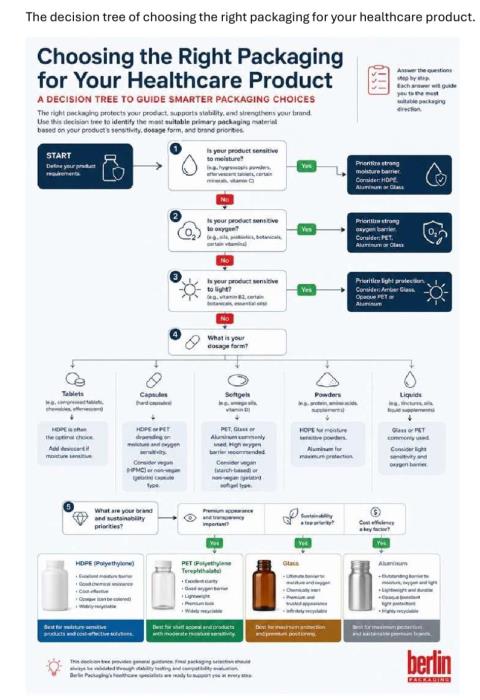
A PRACTICAL DECISION FRAMEWORK
Before selecting a packaging material, manufacturers should ask themselves five fundamental questions:
- Is the product sensitive to moisture?
- Is the product sensitive to oxygen?
- Is the product sensitive to light?
- What dosage form is being packaged?
- What role do sustainability and premium appearance play in the brand strategy?
The answers to these questions will typically guide manufacturers towards the most appropriate packaging solution, whether that solution is HDPE, PET, glass, aluminum or a combination of materials and active packaging technologies.
CONCLUSION
Choosing the right healthcare packaging requires balancing science, product stability, sustainability objectives and brand positioning. The most successful packaging projects begin by understanding the product’s sensitivity to moisture, oxygen and light before considering aesthetics or cost.
"At Berlin Packaging, we believe packaging should never be selected solely because it looks good on the shelf. It should be selected because it protects the product, supports the brand and helps ensure consumers receive the quality they expect throughout the product’s lifecycle."
By Bjarke Arlø
Healthcare Segment Leader EMEA
Berlin Packaging
June 2026