


If this is your company, CONTACT US to activate Packbase™ software to build your portal.
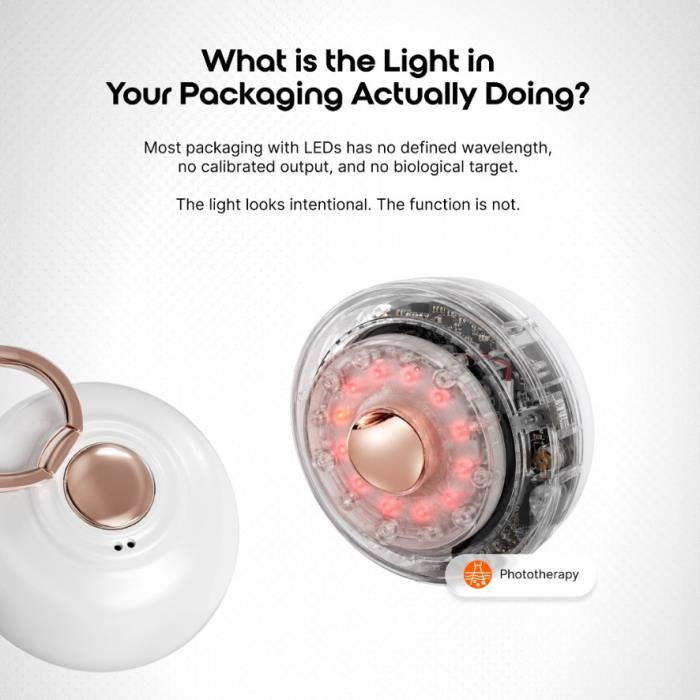

The beauty industry has embraced light: packaging with LED accents, serums photographed under colored light, products named after wavelengths. Light has become its own category.
Engineered phototherapy is something different.
A functional phototherapy system is built around specific wavelengths, calibrated irradiance levels, defined exposure durations, and contact geometry that places the light source where it needs to be relative to the skin. The mechanism is documented. The output is tested. The claim has a foundation.
Aesthetic LED usage looks like technology. Engineered phototherapy functions like technology. The difference matters when a brand needs to support an efficacy claim. It matters when a partner asks for regulatory documentation. And it matters when the end user expects a result, not just an experience.
At Nuon Medical, phototherapy integration starts with the biological target: ATP production, collagen stimulation, and inflammation reduction, and works backward into packaging design, output specifications, and documentation. The LED is the last decision, not the first.
| Aesthetic LED | Nuon Medical's Engineered Phototherapy |
| Purpose: Visual differentiation | Purpose: Functional skin response |
| Wavelength: Unspecified | Wavelength: Calibrated to target tissue |
| Irradiance: Not calibrated | Irradiance: Measured, controlled output |
| Exposure duration: Not defined | Exposure duration: Defined per application |
| Biological target: None | Biological target: ATP production, collagen stimulation, inflammation reduction |
| Documentation: Not applicable | Documentation: DHF-style, output reports, risk assessments |
| Claim support: None | Claim support: Evidence-backed foundation |
If your product uses light, the question worth asking is: what is the light actually doing?