


Public
 Cosmetic packaging Blog/Forum
 Shaoxing Dalica Cosmetic Packaging Co., Ltd Gallery
 Shaoxing Dalica Cosmetic Packaging Co., Ltd Locations
If this is your company, CONTACT US to activate Packbase™ software to build your portal.
Dalica packaging focus on acrylic packaging bottles for your cosmetics and other skincare products,you can easily contact at https://www.dalicapkg.com/talk-to-us/ to custom your own cosmetic containers

The materials of plastic bottles are usually PP, PE, K, AS, ABS, acrylic, PET and so on. PET material is an environmentally friendly material. It has high barrier properties, light weight, unbreakable characteristics, chemical resistance, and strong transparency. It can be made into pearlescent, colored, magnetic white, and transparent. It is widely used in the installation of gel water. The mouth of the bottle is generally 16 #, 18 #, 22 #, 24 # caliber, which can be used with a pump head. AS, ABS: AS has better transparency and better toughness.
The acrylic material is an injection bottle, which has poor chemical resistance. Generally, it is not possible to directly fill the paste. It needs to be equipped with a liner barrier. The filling is not easy to be full, preventing the paste from entering between the liner and the acrylic bottle, so as not to occur Cracked, packaging requirements are high during transportation, because dalica acrylic bottle looks particularly obvious after scratching, high permeability, and the upper wall is very thick, but the price is quite expensive.
1. When designing squeeze plastic bottles, if the material is high-density polyethylene or polypropylene, the cross-section of the plastic bottle should be rectangular or oval. For the material of low-density polyethylene or other flexible plastic bottles, the cross-section Round is better. This facilitates the extrusion of the contents from the plastic bottle. The plastic parts used with the plastic bottle mouth are mainly bottle caps and seals. The design of the plastic bottle mouth should be focused on, considering how to make the plastic bottle mouth better match the bottom of the plastic bottle with the cap and sealer, which is a weak part of the mechanical properties of the plastic bottle. Therefore, the bottom of the plastic bottle is generally designed to be concave. The corners and recesses of the plastic bottle are all made with large arcs. In order to facilitate the stacking of plastic bottles and increase the stacking stability of plastic bottles, an inner groove should be designed at the bottom of the plastic bottles.
2. When the surface of the plastic bottle is labeled, the label surface should be flat. A "frame" can be designed on the surface of the plastic bottle, so that the label can be accurately positioned without movement. In blow molding, the first contact area of the parison inflation always tends to harden first. Therefore, the wall thickness of this part is also larger. The edge and corner parts are the parts where the parison blows up last, and the wall thickness of this part is small. Therefore, the edges and corners of the plastic bottle should be rounded. Changing the surface shape of the plastic bottle, such as the relatively thinner middle part of the plastic bottle, increasing the circumferential grooves or ribs on the surface of the plastic bottle can improve the rigidity and bending resistance of the plastic bottle. Longitudinal grooves or ribs can eliminate the deviation, sagging or deformation of plastic bottles under long-term load.
3. The printed surface of the plastic bottle is the most concentrated part of consumers' attention. The printing surface should be flat and continuous. If the plastic bottle contains structures such as handles, grooves, stiffeners, etc., care should be taken not to cause inconvenience to the printing operation. The oval plastic bottle has higher rigidity, but the manufacturing cost of the mold is higher. Therefore, in order to ensure the rigidity of plastic bottles, in addition to selecting high-stiffness materials, the shape design of plastic bottles must also be used to enhance the rigidity and load resistance of plastic bottles.
4. As most plastics have notch sensitivity, plastic bottles are prone to cracks and cracks at sharp corners, the root of the mouth thread, and the neck, so these parts should be designed with rounded corners. For the intersection of rectangular plastic bottles, it is necessary to support most of the load of the plastic bottle, so locally increasing the wall thickness there is also conducive to improving the rigidity and load resistance of the plastic bottle.
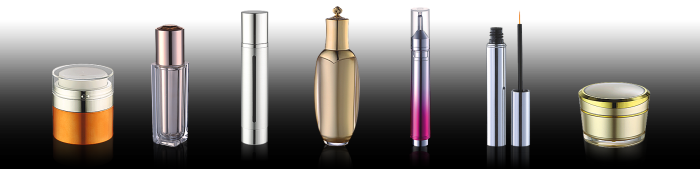
There is a close relationship between cosmetics and plastics. Several types of plastics commonly used as following,collect by dalica:
ABS
ABS belongs to engineering plastics, is not environmentally friendly, has high hardness, and cannot be directly contacted with cosmetics and food. In acrylic cosmetic packaging materials, it is generally the material of inner cover and shoulder cover. The color is yellow or milky white.
PP, PE
PP and PE are environmentally friendly materials, which can be directly contacted with cosmetics and food. They are the main material for filling organic skin care products. The material is white and translucent. According to different molecular structures, three different degrees of softness and hardness can be achieved.
PET
PET is an environmentally friendly material that can be directly contacted with cosmetics and food. It is the main material for filling organic skin care products. PET is soft and the color is transparent.
PCTA, PETG
PCTA and PETG are environmentally friendly materials. They can be directly contacted with cosmetics and food. They are the main material for filling organic skin care products. The materials are soft and transparent. PCTA and PETG are soft and easy to scratch. And it is not commonly used for printing and printing.
AS
AS hardness is not high, brittle (clear sound when knocking), transparent color, and the bottom color is blue, it can directly contact with cosmetics and food. In ordinary lotion bottles, vacuum bottles are generally the material of the bottle body. A small-capacity cream bottle can also be made. It is transparent.
Acrylic
The material is hard, transparent, and the base is white. In addition, Acrylic often sprays in the outer bottle in order to maintain a transparent texture, or paints it during injection molding.